Marvelous May!

Marvelous May!

Braddock Bay fans often enter into the month of May lamenting that the hawkwatching season has past its peak, and it’s all downhill in terms of raptor migration at least.  It doesn’t help that our eyes are easily turned to the colorful menagerie of warblers and other songbirds that make their way along the lakeshore, too.  Warblering is a nice distraction on days when hawks are just not cooperating (and sometimes when they are.)  While it is true that the season’s end is closer at this point, it is far from over and there can be plenty of exciting raptor moments left to be had as the days get longer and the temperatures warm (for the most part!).

The raptor gods seemed to smile on us early in the month, or take pity on us perhaps, for even on a few days with Northeast winds, we still had some decent flights.  Take May 3 for example, when over 6,000 Broad-winged Hawks filtered through, and 52 Bald Eagles as well! http://hawkcount.org/day_summary.php?rsite=353&ryear=2016&rmonth=05&rday=03  A little over 2,000 Sharp-shinned Hawks were also tallied in May, which is almost half of the season total.

Speaking of Sharpies, the banding stations had some great days in May, reminiscent of the good ol’ “Sharpie Madness” days.  Over 150 Sharp-shinned Hawks were banded just during the month of May, and mainly over the course of just a few days.  A nice variety of adults and immatures, males and females were captured.  One of them is pictured above – a gorgeous adult female that was banded and photographed by Barbara French.

The hawkwatch season also ended on a high note, with some great sightings to boast.  The morning of May 25 brought a rarity to our site, as a Mississippi Kite was sighted!  The last Mississippi Kite seen at Braddock Bay was in 2012.  That same day, later in the afternoon, not one but TWO Swainson’s Hawks were tallied as well!  The first to be seen was a light morph, and a dark morph followed it about 20 minutes later. http://hawkcount.org/day_summary.php?rsite=353&ryear=2016&rmonth=05&rday=25

Mississippi Kite from May 25, 2016

Mississippi Kite from May 25, 2016

Two season records were also reached at the hawkwatch in 2016.  First, we had a record number of Peregrine Falcons with 51 for the season!  The previous season record was 45 back in 2004.  Thanks to the extra efforts of counter Ryan MacLean, we also tallied up a new season record for Bald Eagles which ended up being 664 for the season!  The previous record was 648 counted by Luke Tiller in 2013.  To think back to the early days when the hawk counts were just beginning, in the late 1970’s and 1980’s we were lucky to see a couple dozen of these magnificent birds.  Their comeback is truly a conservation success story.

An Owl “Hat-trick”

An Owl “Hat-trick”

Each spring, BBRR volunteers survey the Owl Woods for roosting owls that are utilizing the area as a stop over during migration.  Information gained from this survey helps is used to monitor the habitat usage by the owls, and in turn helps us to manage and protect the area for the future. While the science behind this data collection is important, no one will deny that it is a true privilege to observe these magical raptors in their natural habitat.  Check out our Owl Roost Survey page for more info. 

Read on to see just how magical the woods can be at times here at Braddock Bay, and enjoy the account and photos by BBRR volunteer Zaphir Shamma.  

On March 25, my wife Tanya and I were surveying for owls in Owl Woods. The day was cold and gray with strong winds. Not the best day to be out, but we were hopeful. As usual, we started out in the “classroom”, then met a man from Canada who said there was a Saw-whet back in the pines. We followed in the general direction of where he pointed and quickly found the spot. We could see a Northern Saw-whet Owl about 8 feet high and tucked deep into the tree. The owl was partially obscured by branches from every angle, but we had nice views of its front. It didn’t appear to be too concerned that we were there, and kept its eyes closed while we viewed it.

Peek-a-boo Great Horned Owl, by Z. Shamma

Peek-a-boo Great Horned Owl, by Z. Shamma

We then moved down the path in the direction of the raptor banding station. Tanya wanted to investigate that one large spruce that is off the trail on the right. While searching that area, Tanya reported that she unintentionally flushed “something” and it flew off towards the east. We continued on down the path and rounded the loop. As we began to explore the tall pines on our left, Tanya stopped and said she saw an owl. She pointed about 30 feet off the ground towards a thick pine that was blowing in the wind. The bows were swinging back and forth and finally, I was able to see what she saw (but only for a second). The wind-driven bows would hide, uncover briefly and then re-hide this owl. I took photos as best I could while trying to time the moving branches. While discussing if we should go back and get a better camera lens, the bird pooped, and then bolted silently in a northern direction. It was big and silhouetted, so we couldn’t tell what it was. Once we got home and examined the photos, it turned out not to be a Long-eared Owl as we suspected, rather…it was a Great Horned Owl! We feel that this was the same bird that Tanya had accidentally flushed about 15 minutes earlier.

Lurking Long-eared Owl, by Z. Shamma

Lurking Long-eared Owl, by Z. Shamma

Tanya and I continued to move back towards the entrance of Owl Woods, searching as we went. Once we got close to where the paths come back together, we came across Jim Saller (BBRR volunteer) who had spotted a Long-eared Owl. We quietly joined him and looked at a beautiful bird high in the canopy. It was dark, back-lit and silhouetted, but the outline was crisp and we knew we had a Long Ear. Photos were taken and we moved on.

All in all, not bad for a gray, cold and windy day. Three different owl species (an Owl Hat-trick) in the woods that we have grown to love.

Raptor Banding Update – Careful What You Wish For!

Raptor Banding Update – Careful What You Wish For!

Photo above: Red-tailed Hawk, by Wayne Sheeler
Third week of March 2016, by Barbara French

Report from Main Station:

We love south and southwest winds for hawks. Nothing is better for bringing them right along the lakeshore and right over the banding station, but be careful what you wish for!

The only decent day for banding this week turned out to be Thursday (March 17th, St. Patrick’s Day), so Susie Cotsworth and I headed out for the banding station around 10 AM with high hopes. As it turned out, a couple of matters delayed my getting there by about fifteen minutes, so when I arrived at the station it was to a “Thank God! Here, take this hawk!” as Susie handed me a can-ful of very feisty, large Red-tailed Hawk she had captured right upon opening. We had three rapt visitors watching the spectacle. Susie gave me the hawk for processing so she could turn her attention back to the trapping process. Unfortunately the hawk, a rather large one, was of an awkward neither-nor size – too big for our usual red-tail can, too small for the largest can and nothing suitable in between. I banded her with our largest usual Red-tailed Hawk band, but for safety reasons I didn’t dare weigh her because that would require dropping her legs back into the can. She was a loose fit, and I was afraid once she had room to wiggle, we wouldn’t get her out again without risking serious injury to us (not to her). So after banding, I just pulled her out for the rest of the processing.
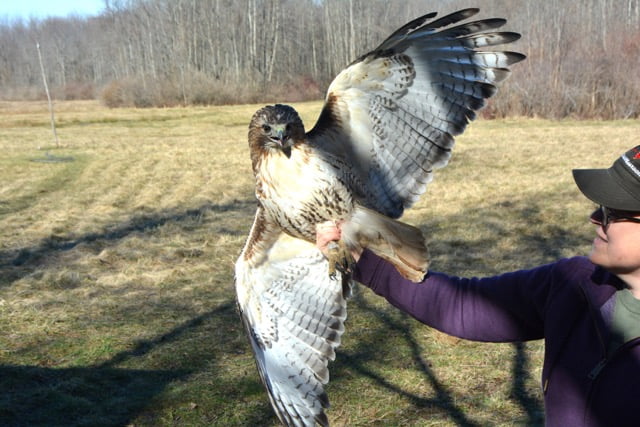
One big Red-tailed Hawk, captured at Main Station in March 2016. Photo by Wayne Sheeler

One big Red-tailed Hawk, captured at Main Station in March 2016. Photo by Wayne Sheeler

Although the skies were absolutely full of birds, we only caught one other adult Red-tailed Hawk before our lovely brisk southwest winds turned into gale force. Not only was it blowing everything around inside the blind, but the smaller birds were being shot off along the lakeshore like they’d been fired out of a cannon! Small accipiters like Sharp-shinned Hawks and Cooper’s Hawks already tend to “pop up” quickly from the trees, giving us little time to respond, but these birds were caught by the wind so quickly that by the time we could react, they were already carried off by the winds beyond their ability to turn around to see what was going on. The winds quickly grew so fierce the few Red-tailed Hawks that were braving the winds seemed reluctant to try to move against them, and soon there were nothing but Turkey Vultures braving the storm from our view.

While we always wish for southwest winds, and stronger ones at that (10-15 miles per hour is about ideal), gusts of 40 mph and up are not conducive to trapping!
Raptor Banding Update – What a difference a year makes!

Raptor Banding Update – What a difference a year makes!

Second Week of March 2016, by Barb French

Last year, Susie Cotsworth and I opened Main Blind in the Owl Woods late in March – and we had to dig out a trench in the snow to run lines to the traps. We froze nearly to death on many of those early days! A frozen lake and ripping lake effect winds kept us chilled and the birds away until well into April.

This year, on Tuesday, March 8th, Dan Niven, Susie and I, with the help of Susie’s wonderful husband Tony, opened Main Blind amidst temperatures in the mid-50s, overcast skies, and warm, mild winds. While the field was pretty wet and squishy, little to no snow was in sight. As opposed to bundling up in long underwear, mittens, hat, and hand warmers, I was out this year in a short-sleeved T-shirt installing traps. Joined later by banding trainee Jim Saller, we installed four bow nets and got two fully rigged with lines, returned our cans and tools to the blind, and got everything organized for what we hope to be a much more successful spring hawk banding season. Daena Ford stopped in to deliver needed paperwork and much-appreciated Girl Scout cookies for those who had ordered them, as well as to handle a few items of business.

What we didn’t see were hawks. The promised southwest winds never materialized, replaced instead by light northeastern winds. Geese, swans, and gulls teased us, but we didn’t see our first raptor until Dan spotted a Turkey Vulture on our way to our traditional after-banding lunch at Jo’s Diner.
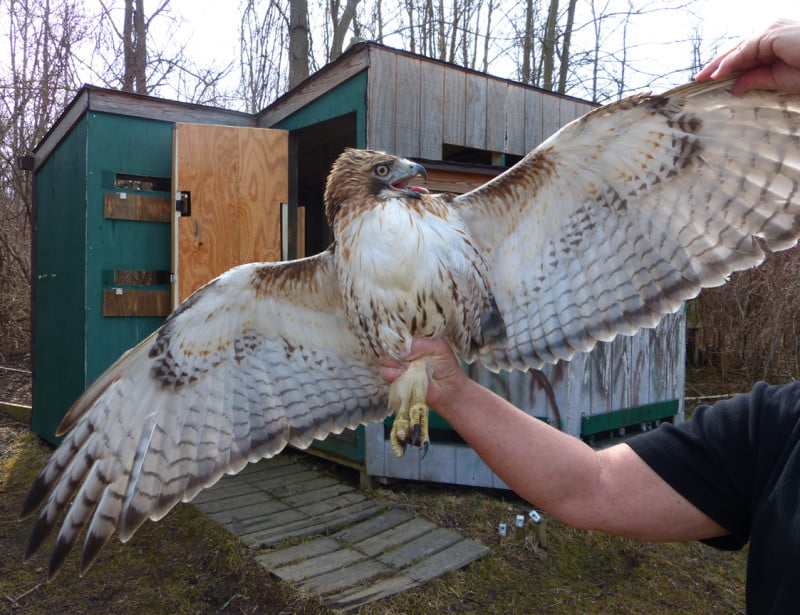
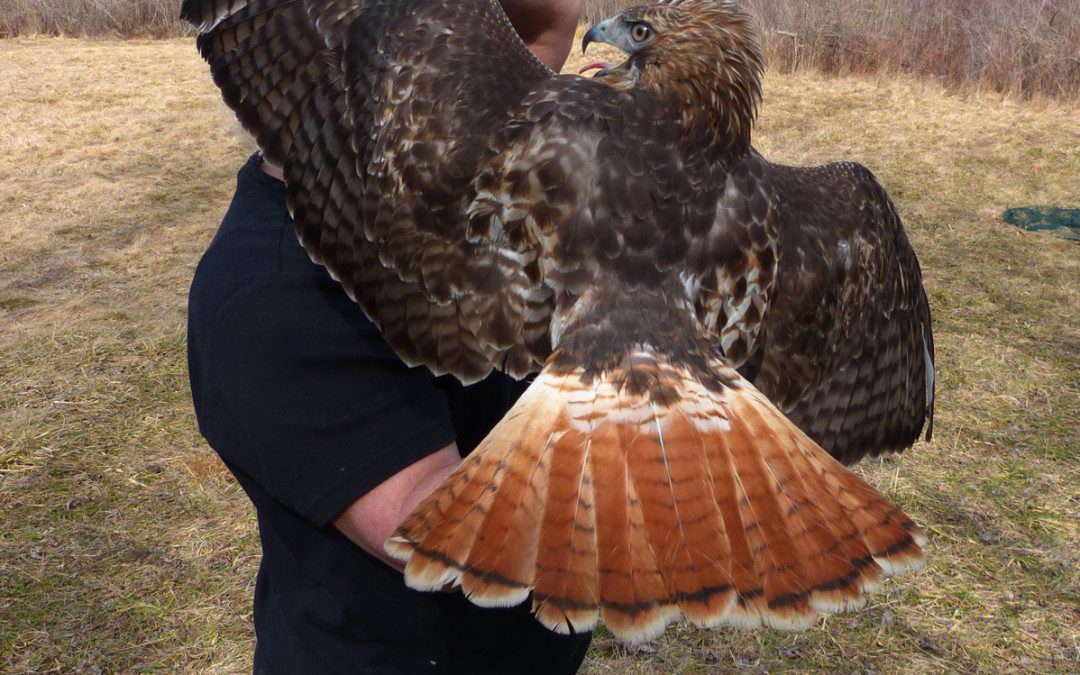
Red-tailed Hawk

Red-tailed Hawk

However, the next day (Wednesday, March 10th) was much more productive. Susie and I saw far more birds than we caught – many Red-tailed Hawks, two nice Rough-legged Hawks, one American Kestrel flitting his way across the field, and several Red-shouldered Hawks, including one so gloriously bold and bright it took our breath away! Visitors were present to see three of our four birds banded that day, all Red-tailed Hawks – two adults and two 2015-hatched juvenile birds.

Saturday (March 12th) looked decent on paper, but a combination of cold, light winds and blue skies sent the birds too high to attract down to earth. One beautiful full-adult Bald Eagle, with glowing white head and tail, graced us with a lower look as it sailed around in the station. Susie and I put the down time to good use to finish running the lines on a third bow trap, so we now have three traps fully operational. Next week will be too rainy for a lot of action, but we’re hoping to get out again when the skies clear up!