Recipe for Adding Native Plants to Any Garden
BBRR is fortunate to have some very talented volunteers, including the author of this article, Carol Erb. Carol is a very experienced landscaper and Master Gardener, who specializes in organic and native gardening. Carol was to be a presenter at Bird of Prey Days this year, but she’ll be taking a raincheck for next year. In the mean time, she wrote this article on native gardening to share ideas that anyone can incorporate into their own landscape. We hope you enjoy giving some of her ideas a try!
At this time when more people are cooking at home, it can also be an opportune time to create a garden buffet for you and the wildlife in your world. I offer you my recipe and resources for putting together a feast for all of your senses, and also a chance to provide a much needed rest stop for the foraging wildlife. As Daena Ford said to me, “Don’t Let Time Be the Only Things on your Hands…Get them Dirty!”
First, some definitions and preparatory instructions before the recipe:
To add flavor and color to your garden, it is important to have some native plant species on hand in the form of shrubs, trees or wildflowers. My recipe is simple: no need to go totally native, but instead add to what you already have in your garden pantry.
Native plants are defined as indigenous plant species that have adapted to specific ecosystems and benefit both plant and animal diversity. New York State has 42 different ecoregions, all with unique plant profiles! Native plants are better able to compete against invasive species than non-native plants.
Know the invasive species already in your yard. Check out www.dec.ny.gov and look up the invasive plant list. Do your best to remove these from your property (often a continuous process). Check before you buy, or before you accept a handout of “free” plants from a generous gardener. Once you can identify and reduce these invaders, it will help to clear the table for your new menu of plants and welcomed guests.
It is essential that your view of “a Weed” is drastically adjusted. Chef Sean Sherman, better known as The Sioux Chef explains, “WEED is a Lazy word. It implies everything you don’t know.” And what we casually call weeds are edible gems to not just pollinators and birds, but were our ancestors’ sustenance. Check out, Bradford Angier’s Field Guide to EDIBLE WILD PLANTS and get cooking! These plants are full of minerals and phytonutrients. Newcomb’s Wildflower Guide by Lawrence Newcomb is also an excellent source.
INGREDIENTS FOR A WILDLIFE GARDEN BUFFET:
Mix in 1 Evergreen. Native is fantastic, like a White Spruce or Eastern Cedar, but if space is an issue; there are many dwarf non-invasive varieties of pine, spruce and arborvitae, hemlock, and holly.
Add 2 Berry Sources– Make sure at least one is for the 2-leggeds as well! Did you know that according to National Wildlife Federation that over 50 species of birds and animals eat Poison Ivy berries? Yes, red is a birds favorite color, but also blue is in too! I recommend Serviceberry (Amelanchier) which comes in bush or tree form. Its berries are super nutritious for all creatures and it is one of the first plants to bloom in the spring, followed by fruit and outstanding fall color. Blueberry, blackberry, red raspberry and the like can all be added and devoured. Choose a native Dogwood (Cornus florida) with its beautiful blooms, fruits and graceful habit for all-season interest.
Add 1 Butterfly/Hummingbird attracting shrub. Try a fragrant Buttonbush (Cephalanthus occidentalis), a true native. Avoid Butterfly Bush (Buddleia), now on the invasive species list. Spicebush (Lindera benzoi) is another choice, a host plant for the Spicebush Swallowtail butterfly. Perhaps you already have your own Lilac Festival? A true magnet for hummingbirds, butterflies and Rochesterians.
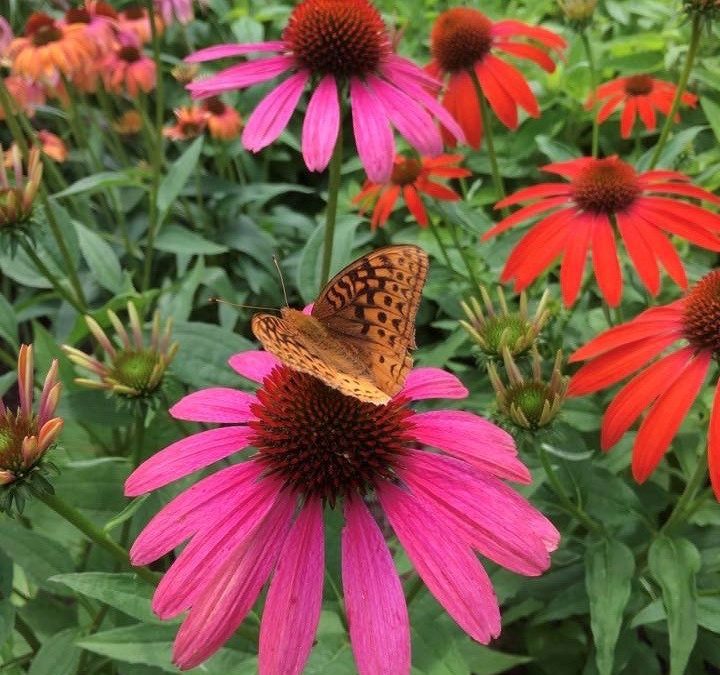
Next, add Seed and Nectar bearing Wildflowers. Pick at least 3 perennial native wildflowers for the birds such as Coneflowers (Echinacea laevigaa, pallida, or purpurea); Black-eyed Susan, Rudbeckia varieties; Beebalm (Monarda); Sunflower perennial natives (Helianthus); Foxglove (Digitalis); Hardy Geranium or Cranesbill; Penstemon; Coral Bells (Heuchera); Foam Flower (Tiarella) and so much more.
* Caution: Avoid or do not purchase cultivars of Native flowers. These Designer Varieties are bred for color and unusual flower shapes. Native species plants evolved side by side with native pollinators. These fancy flower heads can make these plants unusable to our pollinators and deprive them of nourishment. There is a possibility that these flowers could cross-pollinate with native species and be another detrimental force to already fragile habitats. EX.: Cultivars of native Purple Coneflower such as “Honeydew “and “Pink Double Delight” are just two of these pretty new culprits.
Sprinkle in Host Plants to feed the very hungry caterpillars. One of my favorites and a somewhat finicky plant Butterfly Weed (Asclepias tuberosa), is the diminutive orange cousin of our tall, fragrant Common Milkweed (Asclepias syriaca). If you wish to add this beloved host plant of Monarchs, then plant it in a separate area or as a backdrop. It can become aggressive in a small space. Other host sources: Parsley, Dill, Fennel, and Basils. Make Pesto!
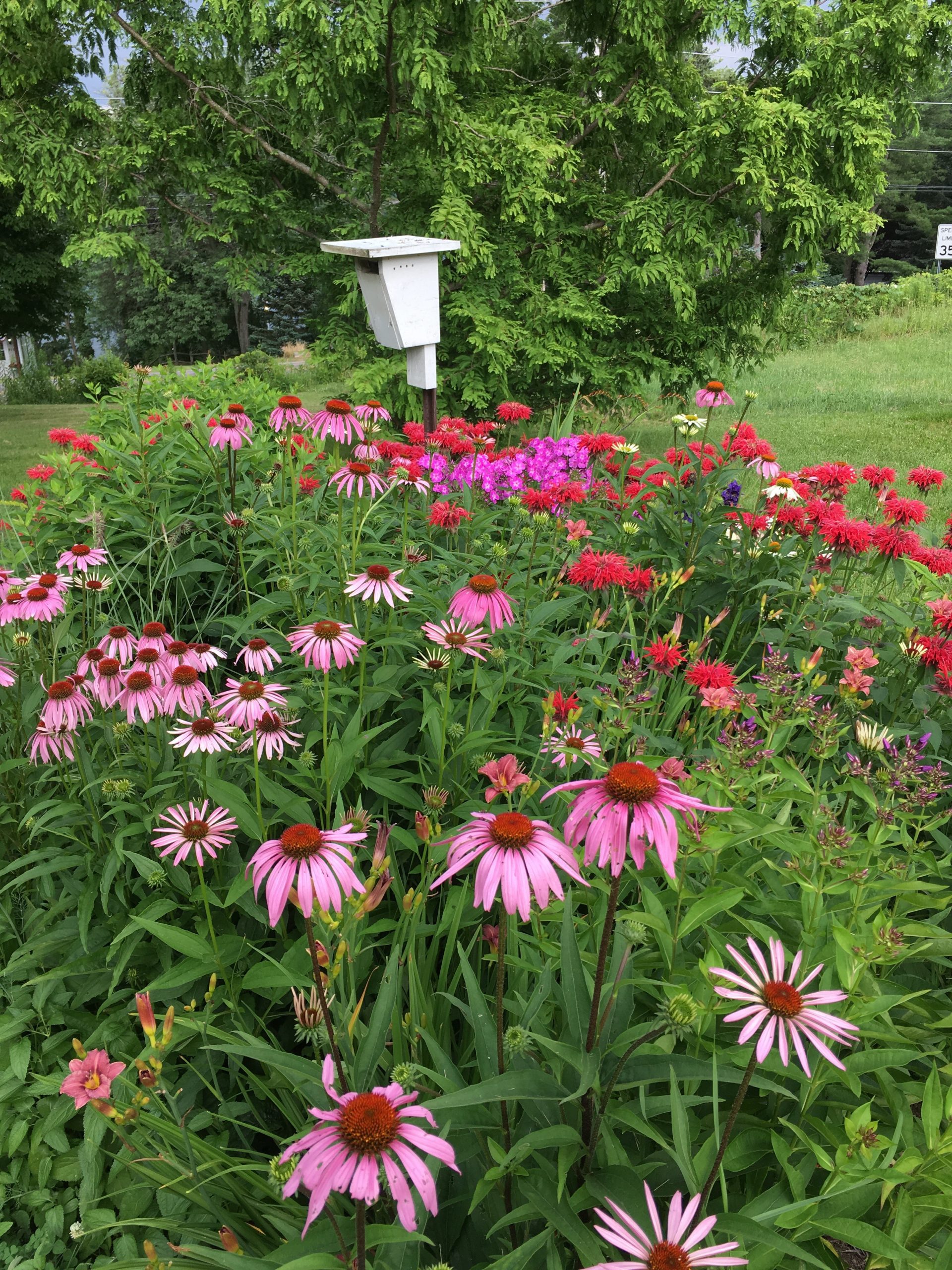
Throw in some Nectar Plants. Butterflies and Hummingbirds are attracted to fragrant flowers (and so are we!):
* Perennials: Columbine (Aquilegia species), Jewelweed (Impatiens capensis), Yarrow (Achillea millifolium), Joe-Pye Weed (Eupatproum species), Daylily (Hemorocallis species), Lavender, Dianthus, Asters, Goldenrod, Autumn Joy Sedum, all Phlox (native and cultivars).
* Annuals: Petunia, Alyssum, Fuchsia, Nicotiana, Nasturtium, and Zinnia
Try a Container Garden by mixing up your own recipe of Nectar and Host plants!
TIME TO SET THE TABLE: The NO-Till Lasagna Method
- Choose a site that is in full sun or partial shade and receives at least 6 hours of sun.
- Outline your bed shape with a garden hose. Be creative. It’s also okay to be square.
- Gather newspaper, it’s lead-free or cardboard. Enough to cover your garden area.
- Have a water can or hose ready. Lay down the newspaper at least 3 pages thick or 1 sheet of cardboard over the sod.
- Water as you go so the paper doesn’t blow.
- Add at least 2-3” of compost. I recommend Brewer’s compost like Nutra-Brew or Mushroom Compost. This is all Weed- Free and helps the environment thru recycling these products.
- Spread compost then add 2-3” of natural NO DYE mulch such as hardwood or pine shredded mulch. Leaves that have been chopped up by mulching mower is perfect.
- Let the garden bake for at least 6 weeks! Now is the perfect time- by mid to late May or early June it’s ready to plant. This method can also be done in the Fall and be ready for Spring planting.
- Start adding your ingredients and remember too that it’s best to start small, you can always bring more to the spread! You are the master chef of your design. Read labels for planting specks.
- Absolutely No Pesticides in this garden or you will be asked to leave the table!
- Add water features, bird houses and stone pathways.
- Try sowing some wildflower seeds.
- Leave the seed heads for an over-winter source of food for the birds. Don’t clean up everything!
Sources to Cultivate Your Mind and Garden: Many of these resources are in our own back yards!
- Monroe County Soil & Water Conservation: monroecountyswcd.org 585-753-7380. Order Native plant materials. Order early Jan./Feb. for April pick up.
- Finger Lakes Native Plant Society. FLNPS.org. A wealth of knowledge and plant sources.
- Native Plant Nursery Directory find local nurseries selling native plants: PlantNative.org
- National Wildlife Federation is an excellent resource! nwf.org/native Get your Wildlife Garden Certified through NWF.
- New York State Park Blog and Plant Materials Program. Check out the cooperative Sonnenberg Garden/Ganondagan grassland restoration habitat program for endangered bird species Go to: https://nystateparks.blog/2020/01/21/growing-the-future-in-gilded-age-greenhouses
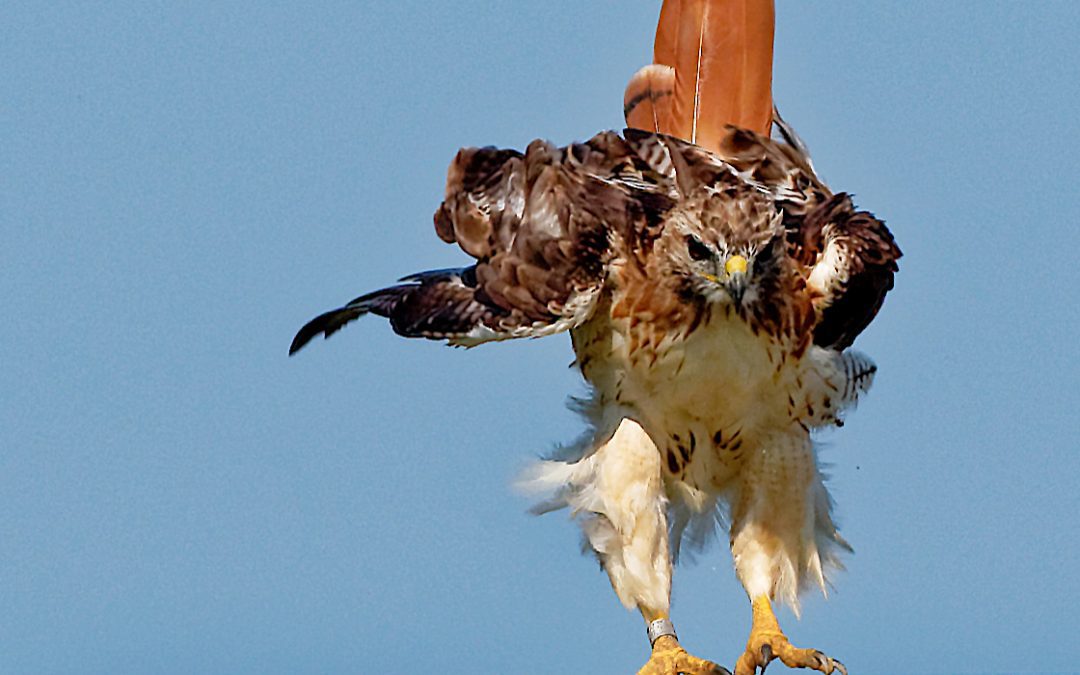
Featured Species: Red-tailed Hawk
Written by Jill Heimrich
Have you ever driven down the expressway or thruway and noticed a fierce-looking, large bird atop the light or telephone pole intently looking at the ground on the side of the road? That bird is most likely a Red-tailed hawk (Buteo jamaicensis), the most widespread and familiar hawk in North America, searching for its next meal. Adults can easily be identified by their cinnamon-red coloring on the top of their tail while the juvenile’s tail is chocolate-brown and banded. Dark belly-bands and patagials (“dirty armpits”) on the leading, underside edge of their wing are two other easily identifiable field markings.
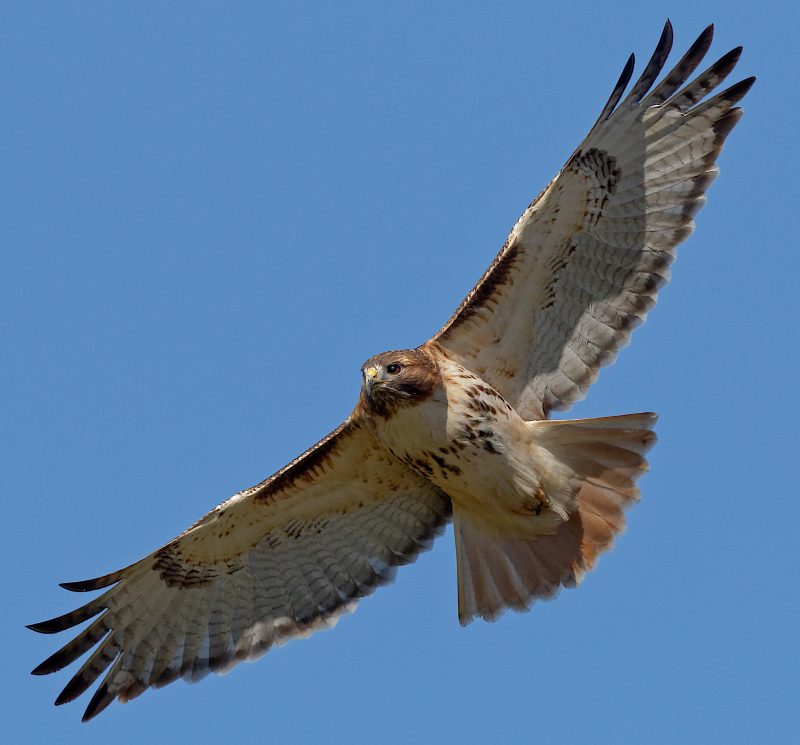
photo by Zaphir Shamma
You may also find this highly adaptable hawk sitting high up in tall trees along open fields waiting to swoop down after their prey, or flying over fields, hunting for a varied diet including mice, voles, snakes, birds and rabbits. They also can be found in your local park or large back yard, if you’re lucky enough, hunting another menu item favorite, squirrels.
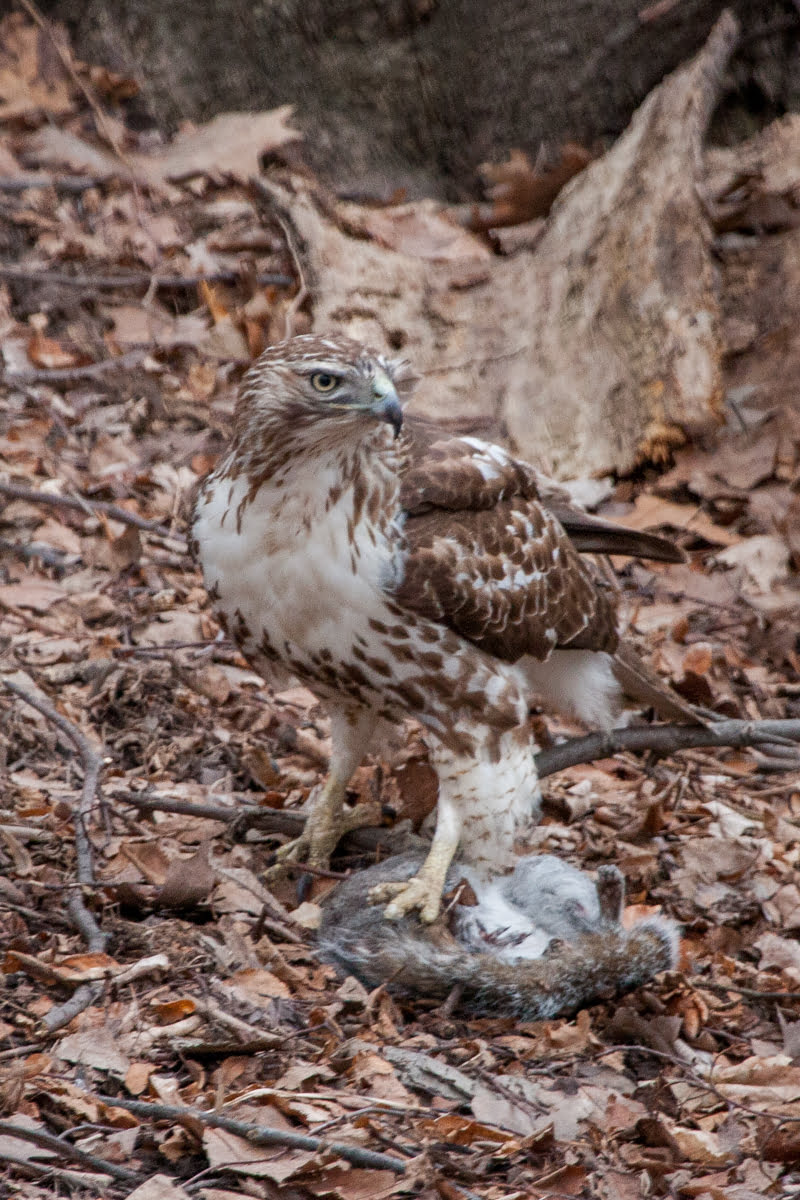
photo by Jill Heimrich
In the north-eastern range, breeding season usually occurs in late February through March, and starts with a courtship ritual such as “sky-dancing” to either start or strengthen their monogamous bond. The female and male soar together in high circles, vocalizing with their hoarse, raspy shrill. The male may fly higher and then dive repeatedly and swiftly in spectacular maneuvers, even touching the female with his talons or passing prey to the female in flight.

photo by Jill Heimrich
Red-tailed hawks are considered partial migrants. Although many are year round occupants, birds of the far north will migrate south in late fall to avoid harsh winters and then will return to their breeding ground in early spring. In late summer and early fall, there is another type of movement called natal dispersal. This is where the juveniles move from their hatch site to find a breeding territory after their parents stop feeding them. Some of the juveniles will stay close to where they were born, while others will move hundreds of miles or more away, creating a false northern migration in some cases.
The Red-tailed hawk is the featured species of this year’s Bird of Prey Days event. Come on out to learn more about this stunning raptor.
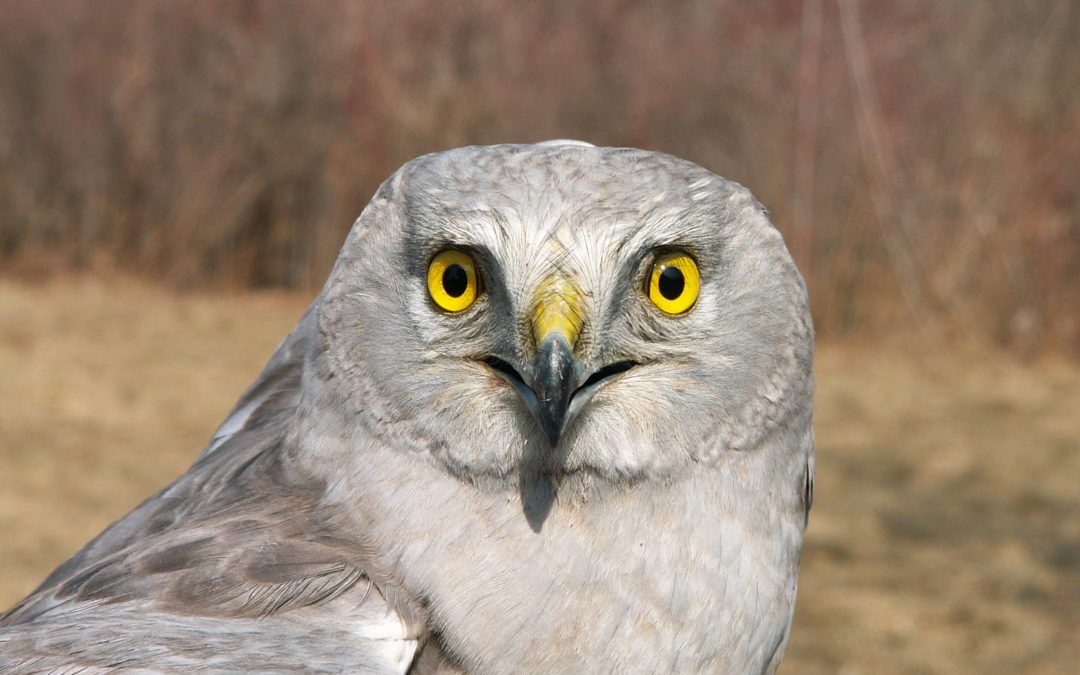
Featured Species: Northern Harrier
Written by Jim Adams
Gliding and bouncing low over the grasslands and marshes of New York state, the Northern Harrier (Circus cyaneus) is one of New York’s more distinctive birds of prey. Unlike high soaring eagles and hawks, harriers spend most of their time close to the ground (except during migration), be it while hunting, roosting, or nesting. In addition to their low altitudes, Northern Harriers can be easily identified by their long tails, white rumps, and owl-like faces.
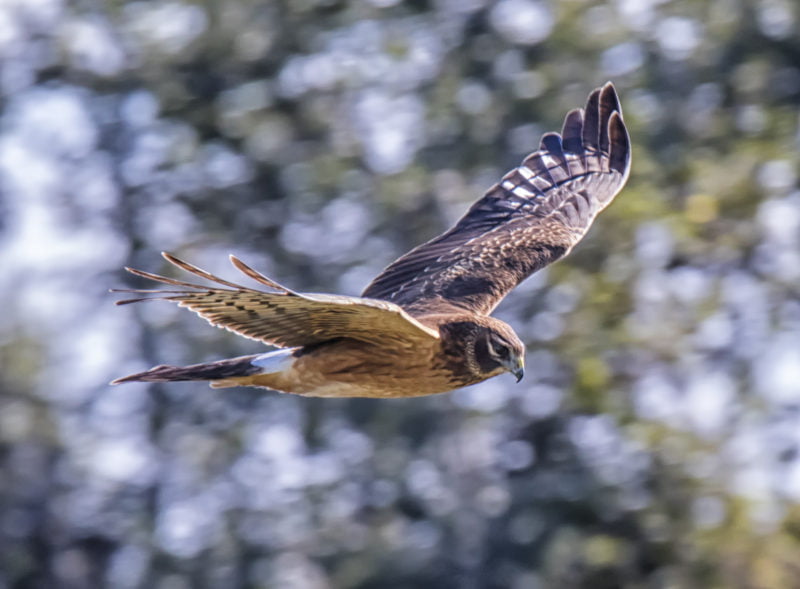
Northern Harrier. Photo by Aaron Winters
New York state is on the southern edge of the breeding range of this species with most Northern Harriers nesting in lower Canada south of the tundra and in Alaska. Unlike the stately nests of the Bald Eagle, harriers nest in tall grassland fields on the ground. During their winter stays in New York state they will also roost communally on the ground, which is why winter birders frequently see more than one harrier hunting over the same field. Small to medium sized mammals (e.g., field mice and voles) and birds are the main items on this raptor’s menu. Harriers are among the early spring migrants, with their communal roosts breaking up in late February and early March so that they can be on their way back to their nesting grounds. Being a bird of the fields, Northern Harrier numbers probably increased when settlers came to New York state and cleared the forests to produce farmland. As agricultural land use have since diminished and the forests subsequently regrown, harrier numbers have declined in response to the loss of field habitats.
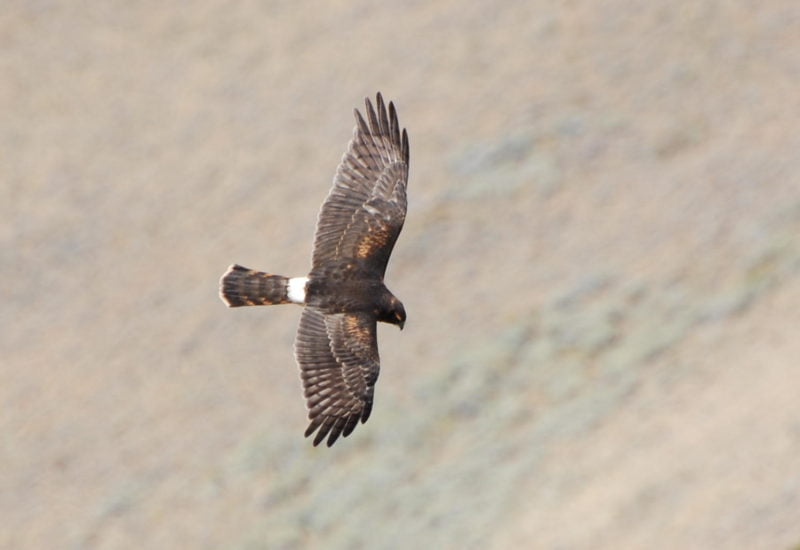
Topside view, showing the white “rump patch”. Photo by Josh Lawrey
The Northern Harrier is the featured species of this year’s Bird of Prey Days event. Come on out to learn more about this stunning raptor.

Male Northern Harrier. Photo by Jill Church
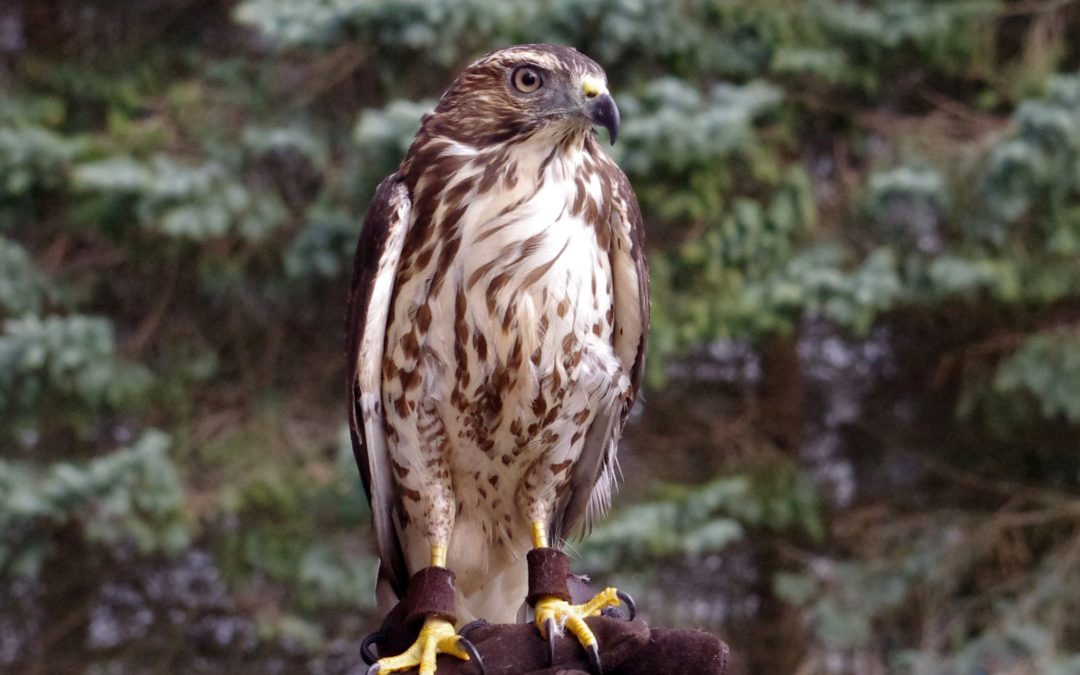
New Feathered Ambassador for BBRR
Nothing excites our visitors more than seeing raptors up close and personal. There are many ways to do that at Braddock Bay, from the hawkwatch to the banding station to the Owl Woods. Encountering wild raptors in their natural habitat is surely a thrill. Just as thrilling is getting to see these birds even more closely, in a way that helps people really connect with the species. BBRR is excited to announce the arrival of a new ambassador for the organization – this non-releasable Broad-winged Hawk.
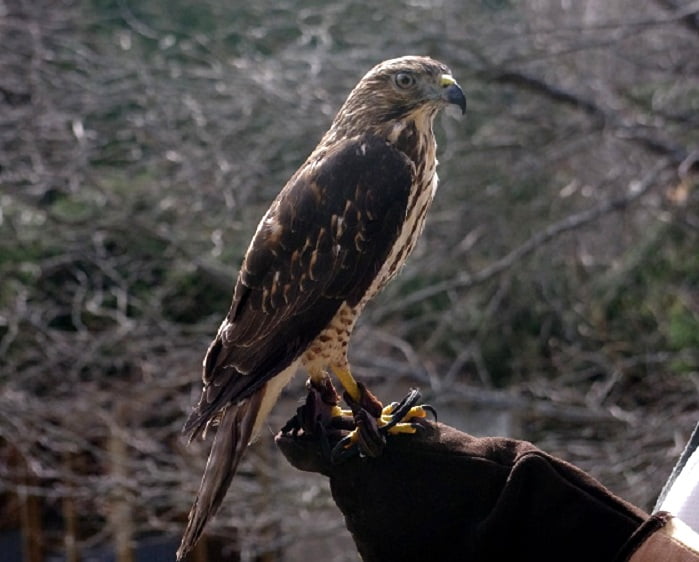
BBRR’s new education Broad-winged Hawk. Photo by Ethan Ford
The Broad-wing comes to us from Kindred Kingdoms Wildlife Rehabilitation Center, north of Syracuse, NY. He came into the care of wildlife rehabilitator Jean Soprano after he was hit by a car near Watertown, NY. Unfortunately he sustained injuries that would prevent his release back to the wild. He is now missing his left eye and also has some permanent damage to one wing. Despite these injuries, he is quite a beautiful bird, and has a very charming personality, making him a good candidate for educational use.
The Broad-wing is a juvenile, hatched sometime last summer, so he is sporting the plumage of a youngster right now. He will molt into his adult plumage this coming summer, which will give him that diagnostic wide white tail band, and his streaky chest will change to one with rufous colored barring. It is believed that he is a male due to his size being on the lower end of the spectrum, and males tend to be smaller than females in the raptor world.
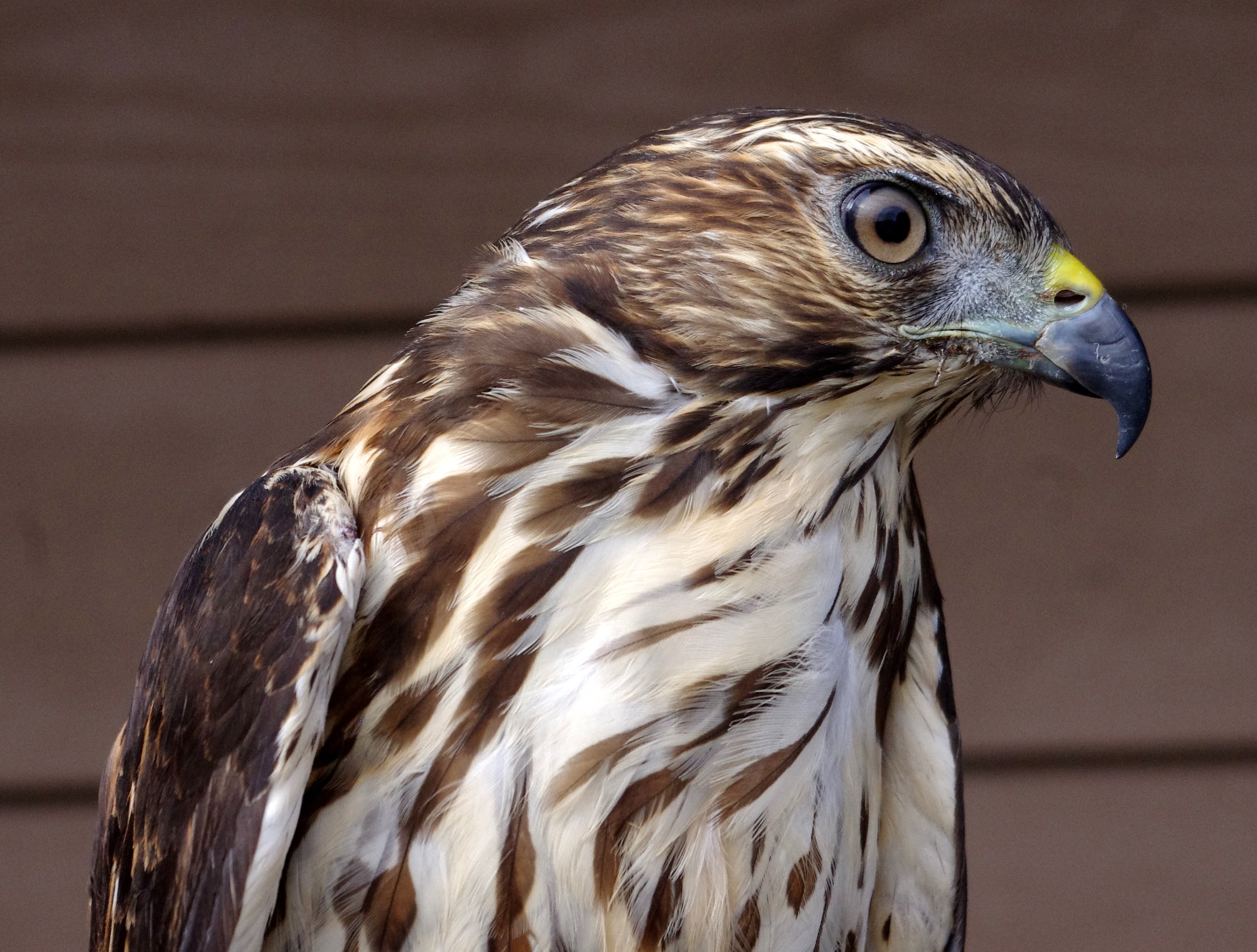
The Broad-winged Hawk is currently sporting some beautiful juvenile plumage. Photo by Ethan Ford
After only a couple of months in his new BBRR home, the Broad-wing has proved he is ready to go out into the world and take on his new job as an education bird. He recently made his first appearance at a local Brownie Troop meeting. The girls were learning about backyard birds and had plans to create some homemade bird feeders. They were the perfect audience to start the Broad-wing out on his new career, as he showed he was very comfortable in his unfamiliar surroundings.
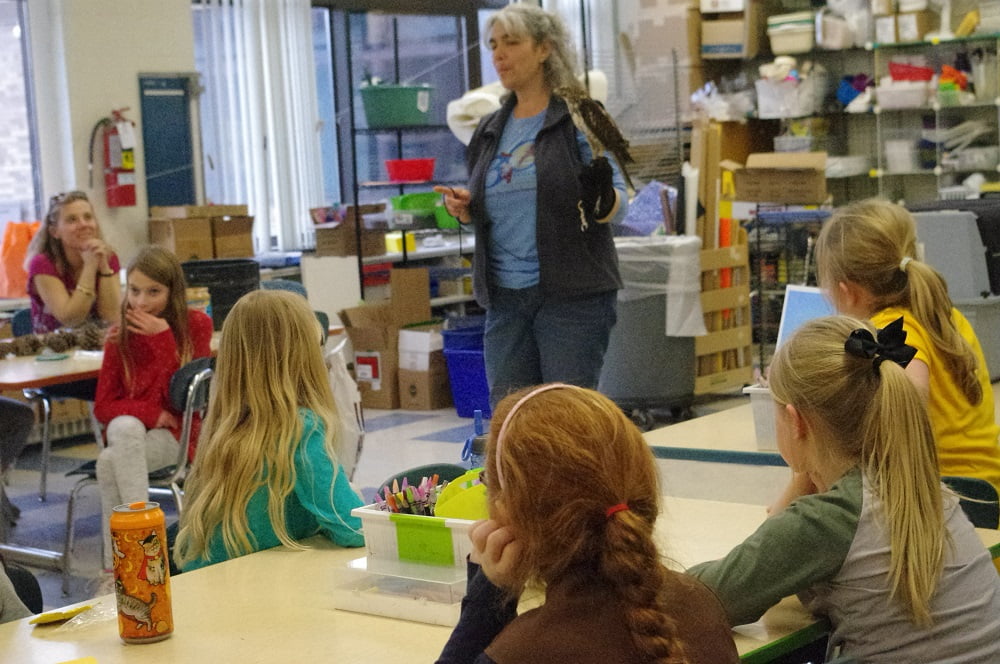
Daena Ford presents the Broad-winged Hawk to some Brownies from Honeoye Falls.
BBRR’s Broad-winged Hawk is the first addition to the new education bird program we are calling Raptor Connections. The goal is to add 3 more birds to the collection, all of which will be program birds, available for outreach and other educational appearances. Stay tuned for updates as we acquire new birds. If you would like to schedule a Raptor Connections program with our Broad-winged Hawk (and other birds in the future), contact Daena Ford at information@bbrr.org or 585-267-5483.
August Red-tail Season Begins!
By Barbara French, BBRR Raptor Bander
“There’s a kettle with 7 eagles!”
The excited text blinked on my phone, and I didn’t even have to wonder who it came from — master bander and licensed eagle bander, Dan Niven. A few exchanges later, I discovered he was out hawk watching, and what was coming next would be a flurry of plans to get Main Blind opened as soon as possible for our late summer/early fall banding season. In a few days, we were out mowing the field and inspecting our equipment in preparation for an on-time start, and perhaps a slightly early one.
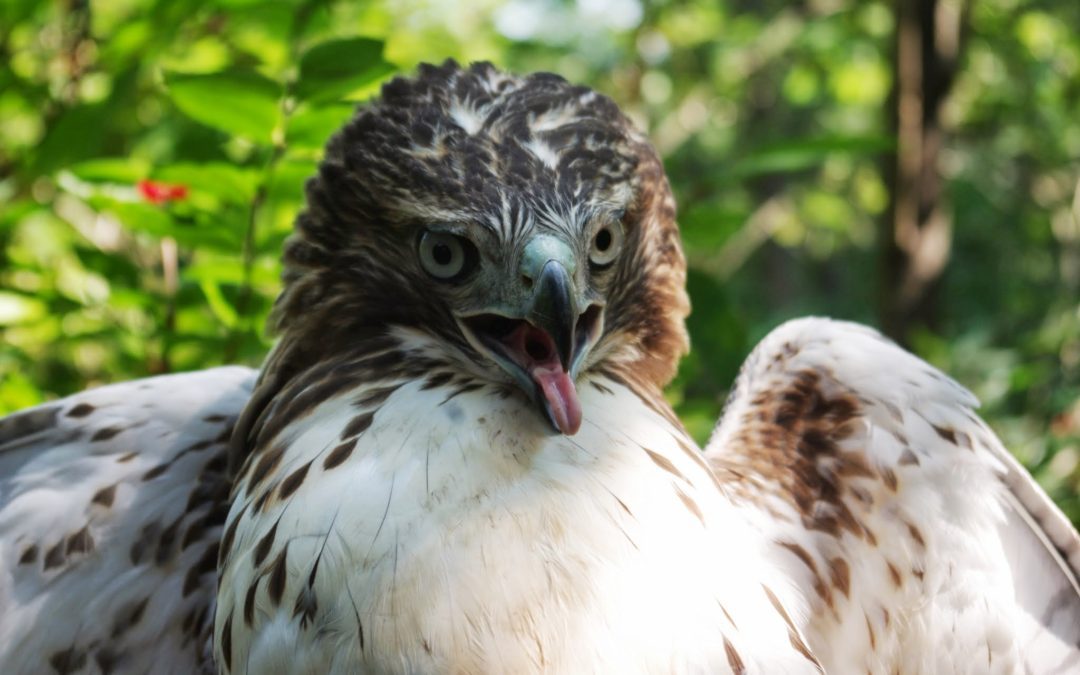
Traditionally, Main Blind opens on August 1 for what is called “Red-tailed Hawk natal dispersal” — a period of time when young Red-tails, some just weeks from fledging, are taking to the skies in number after their parents have stopped hunting for them. While some will stay near where they were born, most Red-tailed Hawks scatter, or disperse, sometimes hundreds or thousands of miles, creating a kind of false northern migration as they are carried on warm summer southwest winds up to the lakeshore. Braddock Bay bands the vast majority of its Red-tailed Hawks, mostly these hatch-year birds, during the months of August and September.
This spectacle is not as well advertised as our famous spring migration. People hawkwatch, but we do not have a hired counter like we do in spring. But late summer is every bit as dramatic as spring — and on some of the days, particularly in the middle of August, downright jaw-dropping. We have had days with “every base loaded” (a Red-tailed hawk caught in every trap in the field) and a couple dozen more circling in the skies above us. It’s a truly awe inspiring sight.
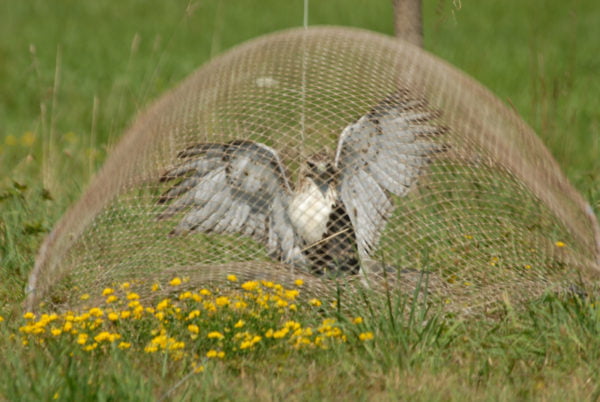
Red-tailed Hawk being captured for banding.
Juvenile Red-tails do not have their famous red tail feathers yet — they will not get these until their third year of life. But the other notable field marks are usually present, including the belly band and the dark patagial markings. These youngsters are inexperienced hunters and are comparatively easy to trap as compared to their more experienced, wily elders (we catch far, far more juveniles than adults), which makes them very interesting to watch as they come into our station.
If you are lucky and our licensed eagle bander is working that day, you might even see a magnificent hatch-year Bald Eagle up close. Many novices to birding do not realize that Bald Eagles do not have their iconic white heads until they are much older. At about 3 1/2 to four years of age, the white head feathers become most visible, although they progressively lighten up through the previous years. Hatch-year eagles are nearly entirely brown, but every bit as large, strong, and impressive as their older counterparts.
This fall, Braddock Bay Raptor Research will be announcing when banders will be at our Main station through our Twitter feed, @BraddckBayHawks. Updates will appear either the evening before or the morning of banding; since weather and wind direction can be so variable, we sometimes do not know until the morning of a banding day whether we are going to have good conditions. If response is good, we will continue this practice for our spring season in 2017.
Just wear bug spray, and a lot of it. The mosquitoes are not as bad as they were last year, but the biting flies are out in force.